
🤝🇨🇳 US and China Playing Nice?
Happy Wednesday all,
The markets are entering midweek with a cautious tone as
Corporate layoffs accelerate
Big Tech momentum cools
US–China trade relations thaw
Companies from Starbucks to Amazon are trimming staff amid shifting cost pressures and the rise of AI-driven automation
AMD’s latest outlook tempered investor enthusiasm after a massive AI-fueled rally
While Beijing’s decision to lift tariffs on U.S. farm goods marks a rare easing of trade tensions
Enjoy this week’s Hump Days!
- Humphrey & Rickie

👀 Eye-Catching Headlines
Pinterest shares plummet 20% on earnings miss, weak forecast (CNBC)
Government shutdown set to become longest ever after latest Senate vote fails (CNBC)
Job openings in October slumped to the lowest level since February 2021, Indeed measure shows (CNBC)
How China’s Chokehold on Drugs, Chips and More Threatens the US (WSJ)
Tesla Is Obsessed With Musk’s Pay Package. Musk Is Obsessed With AI. (WSJ)
Amazon Demands Perplexity Stop AI Tool From Making Purchases (BBG)
The Weekly Brief
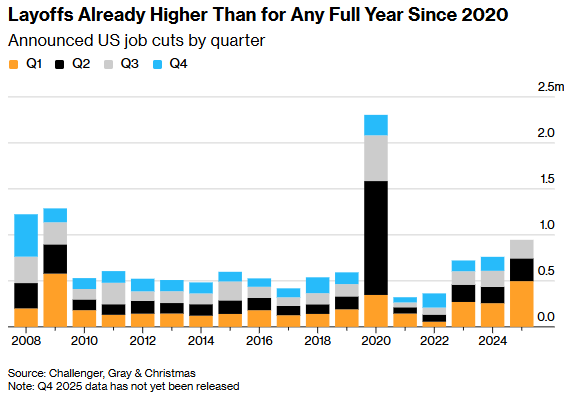
A growing number of significant corporate layoffs, though often individually attributed to unique causes like new management (Starbucks), mergers (Paramount), or AI and automation (Amazon), are collectively raising concerns among some economists.
The recent cuts are starting to look less like isolated cost-saving measures and more like a potential warning sign for the broader US labor market.
Through September, announced US job cuts reached almost 950,000, the highest year-to-date total since 2020. Excluding the pandemic year, this figure has already surpassed the full-year totals for every year since 2009.
This surge in job cuts suggests that managers are broadly losing their fear of firing, possibly emboldened by the prospect of replacing labor costs with AI and automation.
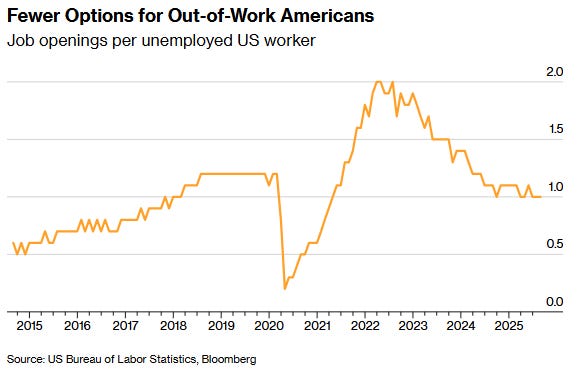
The government sector has seen the most cuts by volume, but tech and retail have also taken hits. Instead of raising prices to cover added costs like tariffs, many large companies are choosing to trim their labor expenses to protect profit margins.
Meanwhile, companies are increasingly relying on temporary workers to fill roles for the long-term permanent staff they are letting go.
AMD Outlook Underwhelms Investors Following AI-Fueled Rally
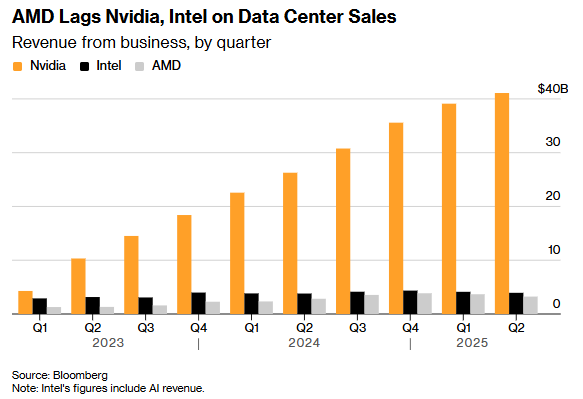
Advanced Micro Devices (AMD), a key competitor to Nvidia in the AI chip market, gave an outlook that led to its shares falling despite beating third-quarter expectations.
The company forecasted fourth-quarter revenue to be roughly $9.6 billion, slightly above the average analyst estimate of $9.2 billion but below some optimistic projections of up to $9.9 billion.
This outlook signaled a slower payoff for AI investments than some investors, who had driven the stock up more than double this year, had anticipated.
Overall, third-quarter sales were strong, rising 36% to $9.25 billion, beating an $8.7 billion average estimate. The data center business, the main focus for AI growth, rose 22% to $4.3 billion, and PC-related sales jumped 73% to $4 billion.
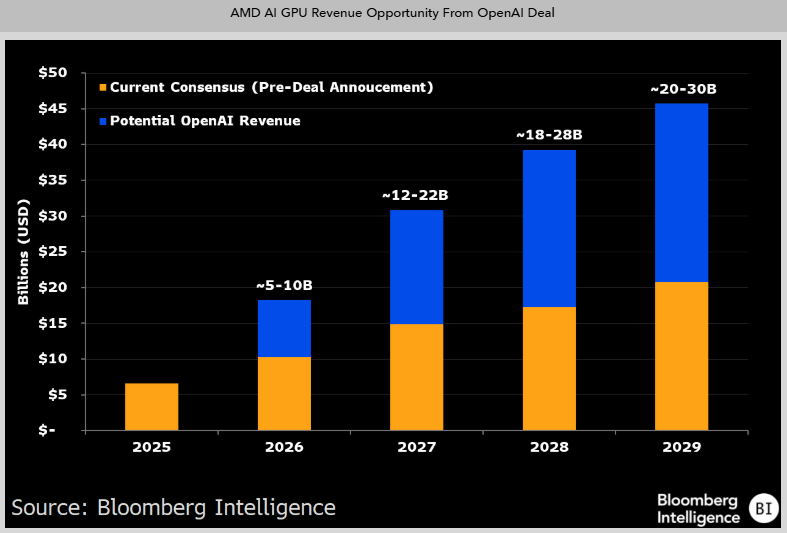
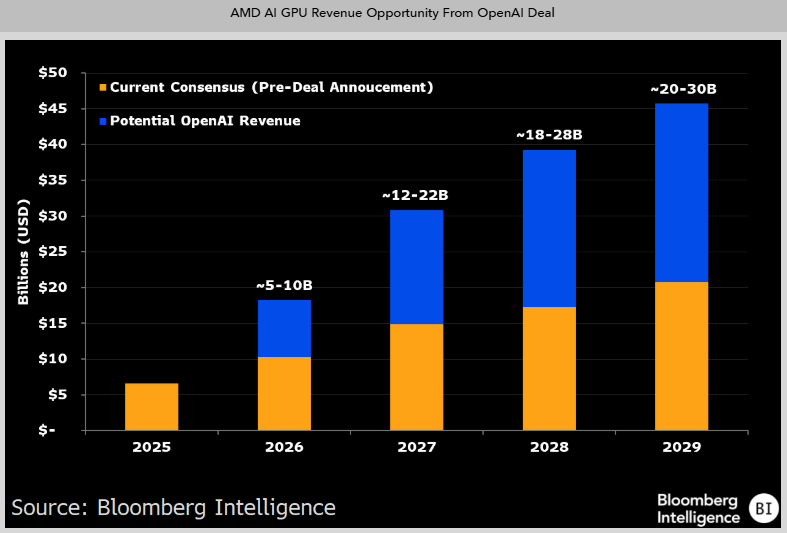
CEO Lisa Su remains highly optimistic about the future, projecting the AI business will generate “tens of billions“ of dollars in annual revenue by 2027, and reiterated that the total market for AI processors could exceed $500 billion a year.
Additionally, AMD secured a significant deal with OpenAI to deploy 6 gigawatts’ worth of its chips, a pact that includes an option for OpenAI to acquire a large stake in AMD.
China Ends Tariffs on US Farm Products After Fentanyl Tariff Cuts
On Tuesday, China suspended retaliatory tariffs on a range of US agricultural products, including soybeans, corn, wheat, and chicken, in response to the US officially halving its fentanyl-related tariffs on Chinese goods.
This action was part of a broader, one-year pact struck between President Trump and President Xi Jinping to stabilize trade ties.
The US formalized its commitment through executive orders, halving the tariff rate on fentanyl-related Chinese exports from 20% to 10% and extending a truce that keeps the reciprocal US tariff rate on other Chinese goods at 10% (down from 34%) for another year.
In exchange, China also pledged to remove export controls on rare earth elements and other critical minerals and committed to increasing purchases of US agricultural exports.
You’ll Find This Interesting
Chart of the Week
In Case You Missed It