
🚢⛽️ Strait Reopened (for two weeks)!
Happy Wednesday all,
Markets are navigating a fragile equilibrium as geopolitical tensions temporarily ease while structural economic risks continue to build. A short-lived ceasefire in the Middle East has provided relief to energy markets, but underlying uncertainties, from labor force contraction to rising scrutiny of private credit, highlight a more complex and uneven macro backdrop. Investors are increasingly balancing near-term optimism with longer-term concerns around growth, stability, and financial risk.
Enjoy this week’s Hump Days!
- Humphrey & Rickie

👀 Eye-Catching Headlines
Delta, Southwest raise checked bag fees $10 amid jet fuel price surge, joining other carriers (CNBC)
Apple shares sink on report of foldable iPhone delays (CNBC)
From Kitty Hawk to Space: America’s Top Innovations in Aviation (WSJ)
A Fire Sale Has U.S. Office Buildings Going for 90% Off (WSJ)
Musk Seeks Ouster of OpenAI CEO Sam Altman as Trial Looms (BBG)
NASA’s Breathtaking Photos From Far Side of the Moon Evoke Wonder and Awe (BBG)
The Weekly Brief
Two-Week Reprieve: US-Iran Ceasefire Reopens the Strait
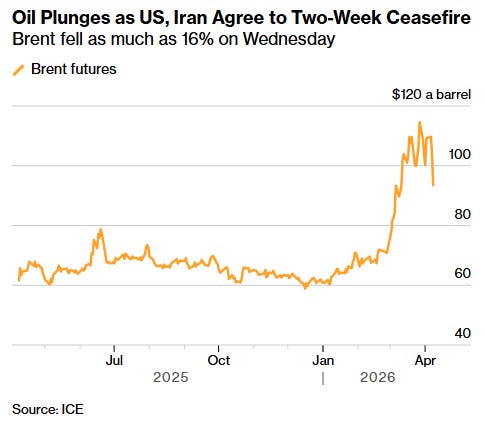
The United States and Iran have agreed to a two-week ceasefire, halting the six-week-old military campaign in exchange for the “complete, immediate, and safe” reopening of the Strait of Hormuz.
President Trump announced the deal on Tuesday, narrowly averting an 8 p.m. deadline for a massive bombardment of Iranian civilian infrastructure.
Mediated by Pakistan, the agreement allows Iran’s military to coordinate safe passage through the vital waterway while both sides suspend offensive operations.
While oil prices immediately slumped from record highs of $144.42 per barrel, experts warn that the underlying issues, including Iran’s nuclear and missile programs, remain entirely unresolved.
The ceasefire marks a significant de-escalation from Trump’s earlier rhetoric, which suggested a total destruction of Iranian civilization. However, critics and some Republican allies, including Senator Lindsey Graham, caution that the deal may reward Iran for its ‘hostile act’ of closing the strait in the first place.
The litmus test for the agreement will be whether international ship owners actually trust the coordination with Iranian forces enough to resume transit.
Labor Force Shrinkage: Participation Hits 50-Year Lows
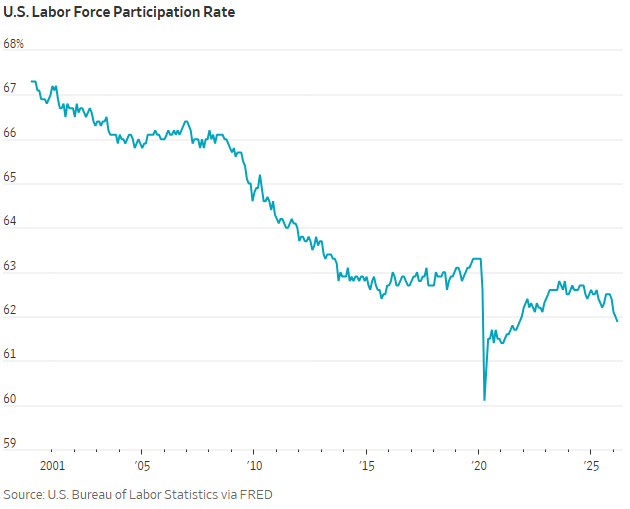
Despite robust job growth in March, the U.S. labor-force participation rate has slipped to 61.9%, its lowest level since 1977 (excluding the pandemic).
This decline is being driven primarily by the accelerated aging of the Baby Boomer generation and a significant “immigration shock” resulting from the Trump administration’s deportation and restriction policies.
Economists are particularly concerned about the 55-and-over demographic, whose participation has dropped to a 20-year low of 37.2%, partly due to workers opting for early retirement to avoid AI-driven workplace changes.
While strong productivity growth has so far masked the impact of a shrinking workforce, experts warn that a smaller pool of workers will inevitably lead to slower long-run economic growth and persistent labor shortages.
On a more resilient note, the participation rate for “prime-age” workers (25 to 54) remains near multidecade highs.
Insurers’ $1 Trillion Buildup in Private Credit Is Leaving Regulators in the Dust
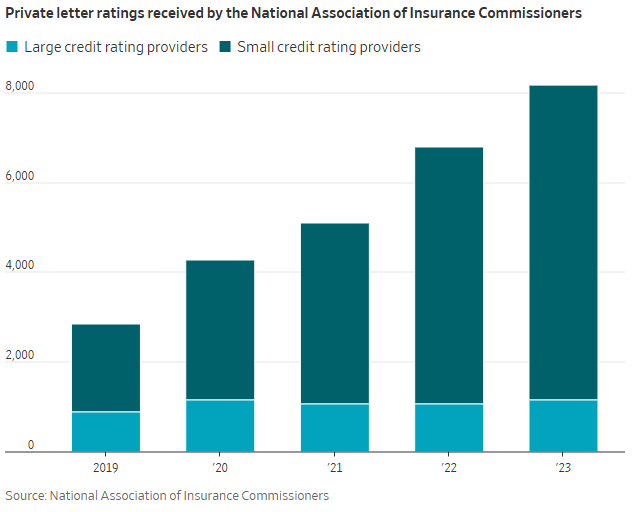
The U.S. Treasury Department is launching an inquiry into the massive influx of private credit within insurance portfolios, following concerns that the risk levels of these loans may be significantly understated.
At the heart of the controversy is a bombshell study by the National Association of Insurance Commissioners (NAIC), which revealed that private letter ratings, often provided by smaller ratings firms like Egan-Jones, were routinely inflated by up to six notches compared to internal regulatory assessments.
Although the NAIC pulled the report in 2024 to clarify findings amid industry pressure, the data showed that nearly $1 trillion of life and annuity assets are now tied to private credit, with hundreds of billions relying on these non-public, potentially aggressive ratings to justify lower capital cushions.
The SEC is currently questioning the integrity of certain ratings firms, while state regulators have finally granted NAIC analysts the power to override ratings that appear more than three notches out of sync with reality.
This shift comes as individual investors begin pulling money from private-credit funds due to fears over the financial health of borrowers.
You’ll Find This Interesting
In Case You Missed It