
🚢⛽️ Hormuz Standoff Eases Slightly
Happy Wednesday all,
Markets are showing tentative signs of stabilization as geopolitical tensions ease, but underlying uncertainty remains elevated. While progress in the Strait of Hormuz has offered some relief to energy markets, investors continue to monitor labor market dynamics and potential regulatory shifts that could reshape corporate reporting and market transparency. The current environment reflects a delicate balance between short-term resilience and longer-term structural risks.
Enjoy this week’s Hump Days!
- Humphrey & Rickie

👀 Eye-Catching Headlines
Trump pauses U.S. bid to guide ships out of Strait of Hormuz, cites Iran deal progress (CNBC)
AMD’s stock soars 15% as data center growth pushes revenue and guidance past estimates (CNBC)
These Are the Hiring Hot Spots Where College Grads Are Landing Good Jobs (WSJ)
I Asked ChatGPT to Manage a Stock Portfolio. Here’s How It Did. (WSJ)
One Calf Shows Why Record Beef Prices Still Aren’t Coming Down (BBG)
The Weekly Brief
Hormuz Standoff Eases Slightly As Oil Markets Remain on Edge
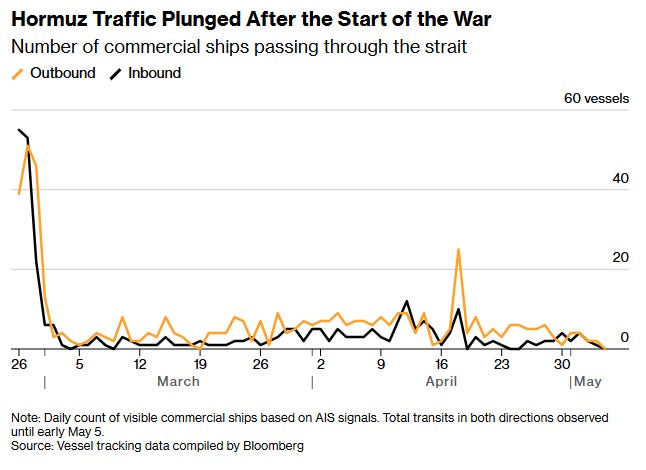
The U.S. declared its offensive military operation against Iran as officially over after 66 days of strikes, with Secretary of State Marco Rubio announcing a shift toward protecting commercial shipping through the Strait of Hormuz.
President Trump also announced a brief pause in “Project Freedom,” a U.S.-led effort to escort stranded vessels through the strait, to allow time for a potential peace agreement to be finalized.
The moves signal growing pressure on the administration to wind down a conflict that has already killed thousands in Iran and is bumping up against the 60-day limit imposed by the War Powers Act.
Despite the ceasefire rhetoric, a cargo ship was struck by an unknown projectile the same day Rubio spoke, and Iran’s president flatly rejected new negotiations as “impossible” under current conditions.
A durable resolution that reopens the strait could deliver meaningful relief on energy prices and ease the inflationary pressure that’s been keeping the Federal Reserve on hold.
U.S. Job Openings Fell in March as Hiring Rebounded
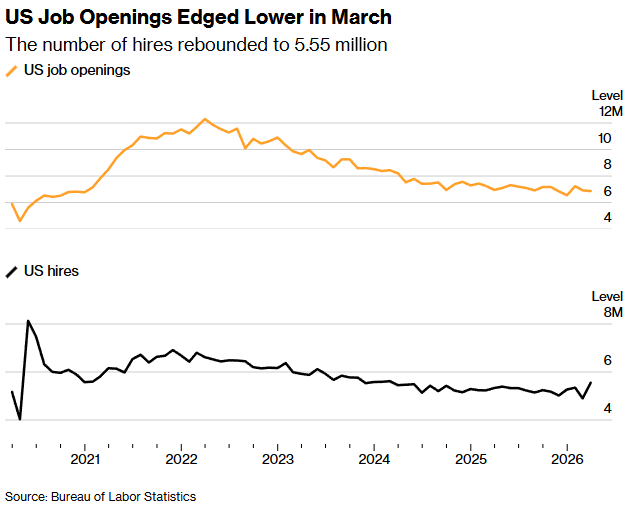
In March, job openings dipped slightly to 6.87 million but remained stable, while the hiring rate jumped back to 3.5% after an unusually weak February, echoing the solid March jobs report that showed employers added 178,000 positions.
Notably, initial unemployment insurance claims fell in late April to their lowest level since 1969, suggesting that high-profile layoffs at companies like Meta, Coinbase, and Nike haven’t yet translated into broad-based job losses.
The labor market remains in a “low-hire, low-fire” mode: jobs aren’t being lost at an alarming rate, but opportunities aren’t abundant either.
The ratio of job openings to unemployed workers sits at 0.9, meaning there are now slightly more job seekers than open positions, a stark reversal from the 2-to-1 ratio in 2022’s hiring boom.
The Fed is watching closely, and a stable labor market gives it less urgency to cut interest rates. Friday’s April jobs report will be the next key data point to watch.
The SEC Wants to Let Companies Report Earnings Twice a Year
The SEC has proposed allowing U.S. public companies to report financial results semi-annually rather than the current quarterly requirement that has been in place since 1970.
SEC Chairman Paul Atkins framed the move as a way to reduce the costs and burdens of being a public company, potentially encouraging more businesses to go public in the first place.
Companies would still have the option to report quarterly voluntarily. The proposal now enters a 60-day public comment period before the commission decides whether to vote on a final rule.
For investors, the debate comes down to a fundamental trade-off: less paperwork burden on companies versus less visibility for shareholders.
Proponents argue that quarterly deadlines push executives to chase short-term earnings targets at the expense of long-term strategy, a view shared by President Trump.
Critics, including Jamie Dimon and Warren Buffett, warn that less frequent formal disclosures could bury bad news, increase insider trading risk, and leave investors flying blind for months at a time.
The EU and UK have both moved toward semi-annual reporting, but most major markets still require quarterly updates.
You’ll Find This Interesting
In Case You Missed It