
🧠💾 Big Tech Earnings Update

Happy Sunday,
Big Tech dominated markets this week, with earnings setting the tone for year-end momentum. Meta pulled off a record $30 billion bond sale despite investor unease over its soaring AI spend. Amazon and Alphabet posted strong cloud-driven growth that eased fears of an AI bubble, while Microsoft’s results underscored the physical limits of the AI boom amid persistent data center shortages.
Enjoy this week’s Sunday Primer.
- Humphrey & Rickie

Market Report
Meta Defies Gloom With Record Bond Sale As Spending Spooks Investors
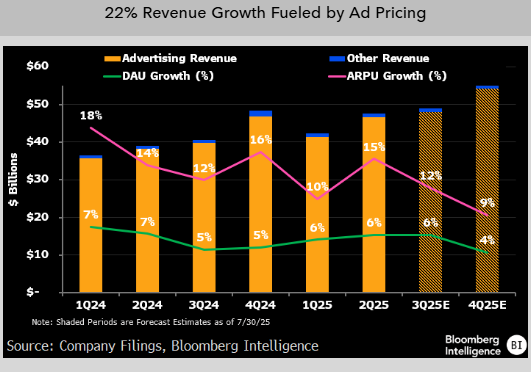
Meta successfully sold $30 billion in bonds, the largest high-grade US bond sale since 2023, drawing a record $125 billion in orders. The strong demand from bond investors occurred despite a fall in Meta’s shares, which dropped as much as 14% after its quarterly earnings report.
The stock market reacted negatively to Chief Executive Officer Mark Zuckerberg’s plan to spend aggressively, up to $72 billion in capital expenditure this year, with an even faster growth rate expected next year on artificial intelligence infrastructure.
Bond investors, who are more focused on the company’s ability to repay its debt, were attracted by Meta’s strong financial performance, including $30 billion in cash flow from operating activities for the quarter.
This financing will help fuel the company’s massive AI investment plans, which Zuckerberg aims to be in the hundreds of billions of dollars over the next decade.
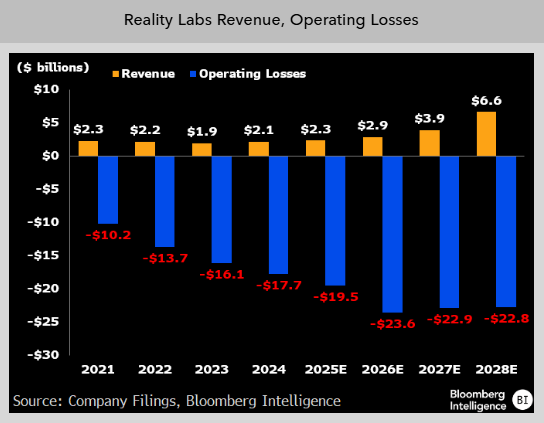
On the other side, equity investors remain concerned that the massive AI investments, which include the hardware unit Reality Labs reporting a $4.4 billion operating loss in the third quarter, may not yield sufficient returns to justify the expenditure.
Amazon’s Cloud Acceleration Calms Investor Fears of AI Bubble
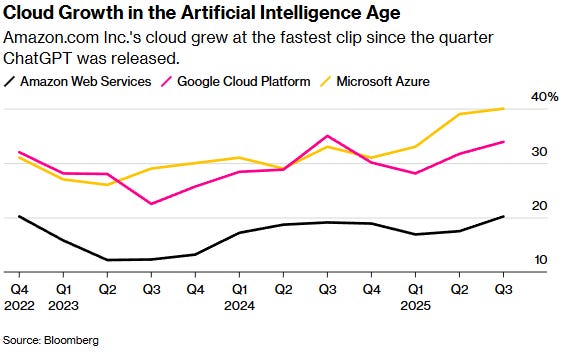
Amazon posted strong Q3 results, driven by AWS revenue of $33 billion, a 20% increase year-over-year. This growth exceeded analyst expectations of 18% and marked the fastest acceleration since the release of ChatGPT.
The strong AWS performance reinforces the reasoning for major tech companies like Amazon, Microsoft, and Google for massive AI spend, and that the demand for AI computing capacity is outstripping global supply.
To keep pace in the AI arms race, Amazon’s capital expenditures soared 61% to $34.2 billion in the quarter, with the power capacity of the AWS data center fleet having doubled since 2022 and expected to double again by 2027.
Alphabet Rises on Sales Beat Fueled by Google Cloud Unit Growth
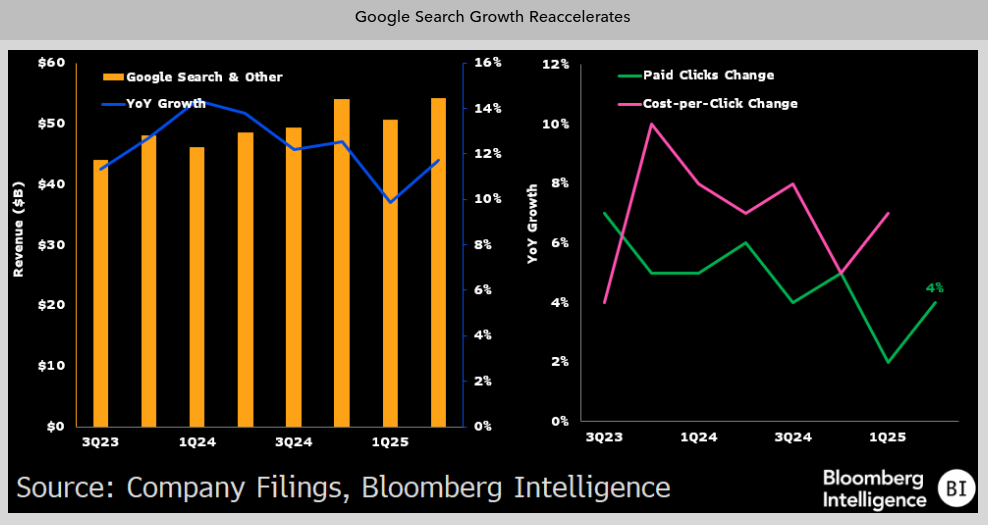
Google reported strong third-quarter earnings, with sales rising to $87.5 billion, surpassing the expected $85.1 billion, and net income hitting $2.87 per share. The performance reassured investors, despite the company raising its capital expenditure forecast for the year to $91 billion to $93 billion (up from $85 billion).
Unlike competitors like Meta and Microsoft, whose shares fell on similar spending projections, Alphabet successfully demonstrated that its massive AI investments are translating directly into business growth, with CEO Sundar Pichai noting that revenue from products built on its generative AI models grew more than 200% from a year earlier.
Its cloud and search businesses spearheaded the company’s success. Google Cloud saw sales grow 33.5% year-over-year to $15.2 billion and reported a profit of $3.59 billion, beating estimates. Search advertising brought in $56.6 billion, while YouTube revenue reached $10.3 billion.
Alphabet is allocating about 60% of its capital expenditure to servers and the rest to data centers and networking equipment to support its expanding AI operations.
Microsoft Data Center Crunch Persists Despite Heavy Spending
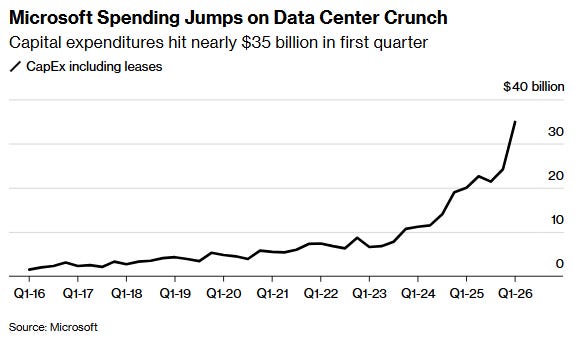
Microsoft reported strong financial results, but reported a severe computing capacity shortage. Chief Financial Officer Amy Hood stated that demand for Azure cloud services is “significantly ahead of the capacity we have available,” and the company does not expect to catch up soon.
Despite this constraint, the Azure cloud unit still posted a robust 39% revenue gain.
To address the shortage, Microsoft is drastically increasing its spending on server farms, with capital expenditures hitting a massive $34.9 billion in the quarter.
Furthermore, the company faces growing risks in its massive data center build-out due to local backlash, citing “community opposition and hyper-local dissent” that could impede or delay infrastructure development, a problem displayed when Microsoft recently dropped plans for a data center in Wisconsin.
Forecast Ahead
Big Number
Overcome the Sunday Scaries

In Case You Missed It
What stands out here is how Alphabet managed to avoid the equity market punishment that hit Meta and Microsoft despite similar capex guidance increases. The key differnce is demonstrating direct revenue impact from AI investments with that 200% growth in generative AI product revenue. Google Cloud's 33.5% growth and $3.59B profit shows they're not just spending on infrastructure but actually monetizing at scale. The balance between Search ($56.6B), YouTube ($10.3B), and Cloud creates real optionality if any segment faces headwinds.